
DBA Research & Applied Governance Portfolio

Chandini Sheeba
DBA Researcher
Ethical Leadership | AI Governance and Cybersecurity Maturity
Research Focus: Ethical leadership, AI governance, and cybersecurity maturity in AI-enabled organizations.
Applied Portfolio Focus: Cybersecurity governance, human-algorithm collaboration, enterprise resilience, enterprise architecture, and augmentation-driven organizational design.
About
I am a Doctor of Business Administration researcher examining the relationship among ethical leadership, AI governance, and cybersecurity maturity in AI-enabled organizations.
My work is grounded in the understanding that cybersecurity is no longer solely a technical challenge. As artificial intelligence becomes embedded in organizational decision-making, resilience increasingly depends on leadership judgment, governance structures, accountability, responsible technology oversight, and the ability to manage interactions between people and intelligent systems.
Alongside my doctoral study, I develop independent frameworks and applied case studies addressing AI governance, cybersecurity resilience, enterprise architecture, and organizational transformation. These projects form a separate scholar-practitioner portfolio that connects academic ideas with real-world governance and operational challenges.
Doctoral Research
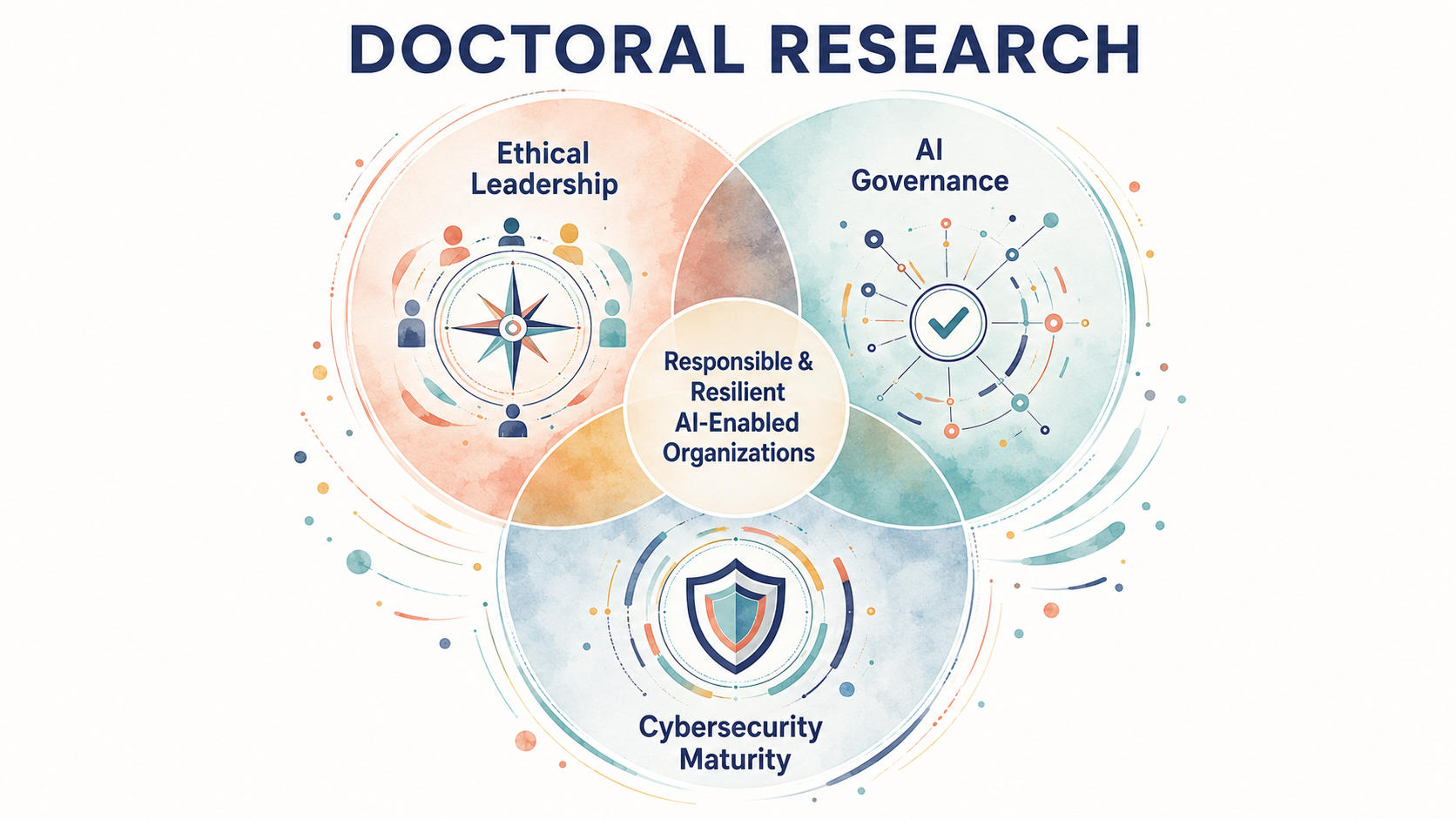
The Impact of Ethical Leadership on Cybersecurity Maturity: The Mediating Role of AI Governance
My doctoral research examines how ethical leadership may influence cybersecurity maturity and the role AI governance may play in translating leadership values into organizational capability within AI-enabled environments.
The research brings together three areas that are often studied separately: leadership, AI governance, and cybersecurity maturity. It considers how accountability, transparency, responsible decision-making, and organizational oversight may contribute to stronger cybersecurity capability.
The study is based on the premise that leadership values become meaningful when they are reflected in governance structures, organizational practices, and accountability systems. AI governance may therefore provide an important connection between ethical leadership and an organization’s ability to manage cybersecurity risk.
The research seeks to contribute to a more integrated understanding of leadership, governance, and cybersecurity while remaining relevant to organizations navigating responsible AI adoption and digital transformation.
Research Themes
My doctoral research addresses the following themes:
Ethical Leadership
AI Governance
Cybersecurity Governance
Cybersecurity Maturity
Responsible AI
Organizational Accountability
Technology-Risk Oversight
AI-Enabled Organizational Environments
Detailed hypotheses, research instruments, analytical procedures, and unpublished findings remain part of the formal dissertation and are not reproduced in this public portfolio.
Independent Applied Governance Portfolio
The following frameworks and projects are independent of the empirical DBA study. They demonstrate how related principles of leadership, governance, cybersecurity, enterprise architecture, and organizational design can be applied to practical organizational challenges.
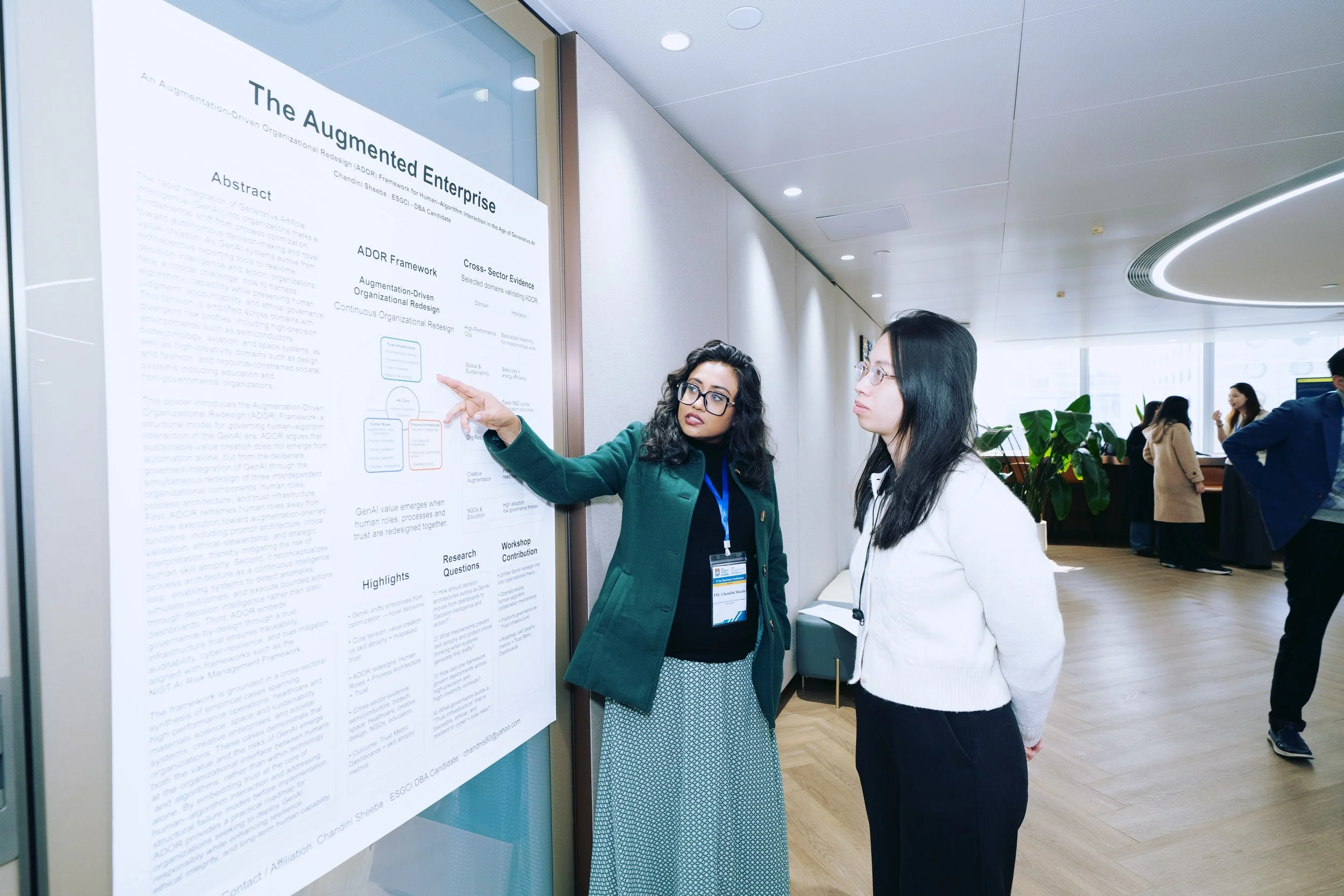
Augmentation-Driven Organizational Redesign — ADOR™
ADOR™ is an applied framework for examining how organizations must redesign work, processes, and governance as artificial intelligence becomes embedded in enterprise decision-making.
The framework is organized around three interconnected areas:
Human Roles — Augmentation Over Automation
ADOR™ considers how artificial intelligence can strengthen human judgment rather than simply replace human participation.
As routine activities become increasingly automated, people can move toward responsibilities requiring interpretation, critical thinking, contextual judgment, ethical reasoning, and oversight of algorithmic outputs.
Process Architecture — Continuous Intelligence Systems
ADOR™ examines how organizations can move from static reporting and isolated automation toward more responsive systems capable of supporting continuous analysis, informed decision-making, and organizational learning.
The framework emphasizes that intelligent systems must operate within clearly defined processes, decision rights, escalation structures, and human-review requirements.
Trust Infrastructure — Governance by Design
ADOR™ recognizes that responsible AI adoption requires governance mechanisms that support accountability, transparency, traceability, security, and effective human oversight.
Trust must be designed into AI-enabled processes rather than added after systems have already been deployed.
Through these three areas, ADOR™ positions human agency, intelligent processes, and governance as interdependent elements of organizational transformation.
Related Writing
Selected Cybersecurity and Governance Projects
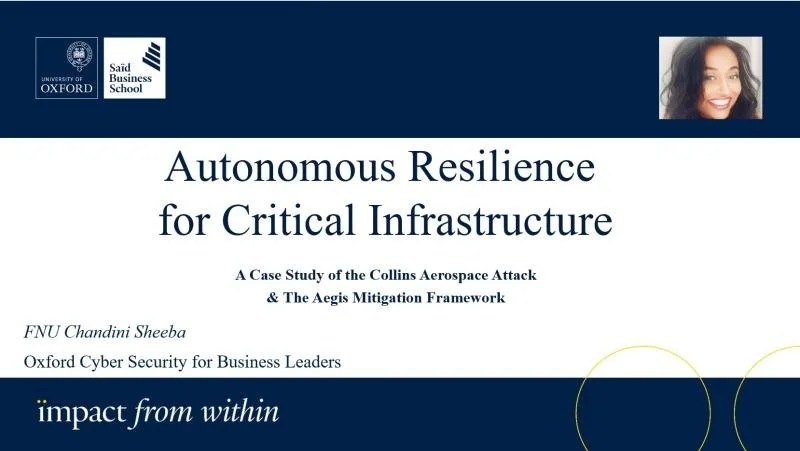
Autonomous Resilience for Critical Infrastructure
A Case Study of the Collins Aerospace Cyberattack and the AEGIS™ Cyber-Resilience Framework
This independent case study examines the governance and systemic-risk implications of a cyberattack affecting shared aviation technology infrastructure.
The project considers how dependence on interconnected platforms can allow disruption affecting one provider to create operational consequences across multiple organizations.
Using the AEGIS™ Cyber-Resilience Framework, the study explores how organizations can strengthen prevention, containment, recovery, operational continuity, and human oversight.
The project demonstrates the importance of designing cybersecurity architectures that can respond to threats while preserving essential services and maintaining appropriate human accountability.
This work was completed as part of the University of Oxford Cyber Security for Business Leaders Programme. It is part of my independent applied cybersecurity portfolio and is separate from my empirical DBA study.
Enterprise Architecture and Licensing Consolidation Strategy
Governance-Driven Enterprise Modernization
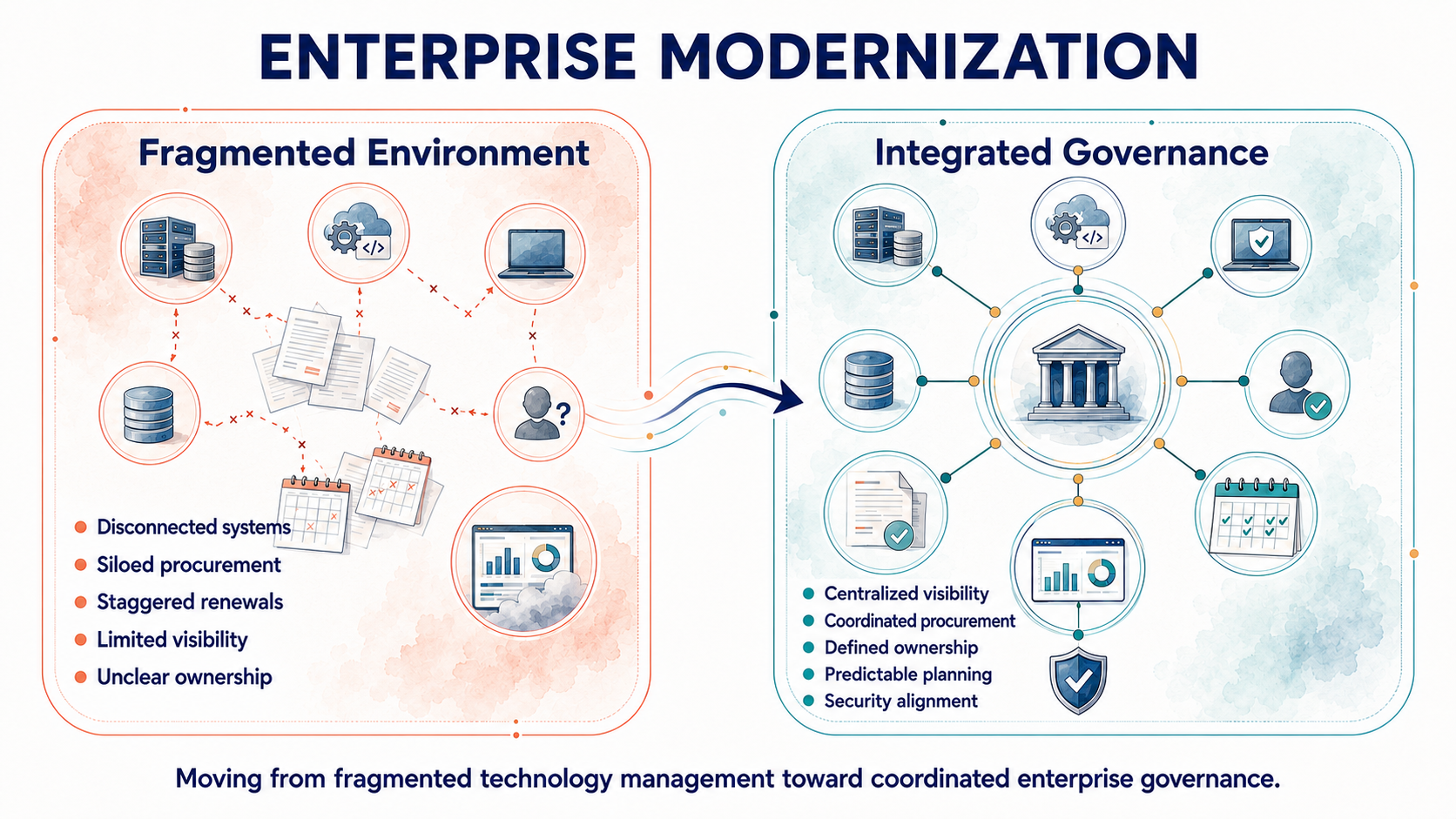
This independent project examines how fragmented technology licensing, disconnected systems, staggered contract renewals, and siloed procurement processes can reduce operational visibility and complicate technology-risk oversight.
The proposed strategy connects enterprise architecture, procurement, licensing, cybersecurity, and financial planning through a more coordinated governance model.
The project considers opportunities to achieve:
Centralized technology visibility
Reduced administrative complexity
Improved budget predictability
Clearer technology ownership
Better coordination among architecture, procurement, and security functions
Stronger alignment between infrastructure and cybersecurity requirements
Governance-driven enterprise modernization
The case study illustrates that enterprise modernization is not simply a technology-purchasing exercise. It is also a governance challenge involving accountability, decision rights, operational visibility, financial stewardship, and risk ownership.
Applied Assessment Portfolio
My independent applied portfolio includes:
57 AI, digital-governance, and cybersecurity assessments
44 organizations
Eight sectors
The portfolio includes cybersecurity-incident analyses, AI-governance evaluations, technology-risk assessments, enterprise-governance case studies, third-party-risk analyses, accountability reviews, and organizational-resilience assessments.
These assessments are not part of the dissertation dataset. They demonstrate the practical application of governance, leadership, cybersecurity, and organizational-design principles across varied organizational contexts.
Broader Applied Themes
My independent frameworks and projects address:
Human-Algorithm Collaboration
Enterprise Resilience
Critical-Infrastructure Resilience
Enterprise Architecture
Digital Governance
Responsible Augmentation
Organizational Design for AI
Technology and Cybersecurity Risk
Governance by Design
Human Accountability in AI-Enabled Decisions
Why This Work Matters
As organizations increasingly depend on AI-enabled decision systems, shared technology platforms, and interconnected digital ecosystems, cybersecurity failures frequently reveal weaknesses in governance, accountability, organizational coordination, and executive oversight—not only weaknesses in technology.
Organizations must therefore consider how leadership, governance, architecture, and cybersecurity operate together.
My doctoral and applied work explores how institutions can move from:
Reactive security → Resilient security
Fragmented oversight → Integrated governance
Unclear accountability → Defined decision rights
Technology-first transformation → Governance-led transformation
Automation → Responsible augmentation
The objective is to support organizational environments in which AI innovation, cybersecurity resilience, ethical leadership, and effective governance can develop together.
Academic and Practitioner Relevance
My work connects leadership research, AI governance, cybersecurity maturity, enterprise architecture, and organizational design.
The doctoral research seeks to contribute to academic understanding of how leadership and governance may influence cybersecurity capability in AI-enabled organizations.
The applied portfolio translates related principles into frameworks and case studies relevant to:
Researchers studying leadership, governance, and cybersecurity
Executives responsible for AI adoption and digital transformation
Cybersecurity and technology-risk professionals
Governance, compliance, and responsible-AI leaders
Organizations strengthening enterprise resilience
Boards overseeing technology and cybersecurity risk
Policymakers considering governance expectations for AI-enabled institutions
Academic Direction
My long-term research direction brings together ethical leadership, AI governance, cybersecurity maturity, human-algorithm collaboration, enterprise architecture, and organizational resilience.
Through my DBA research and independent applied portfolio, I aim to develop work that is academically rigorous, practically relevant, and useful to organizations navigating the governance challenges of artificial intelligence and cybersecurity.
Future directions include:
Completion and dissemination of the DBA research
Practitioner and peer-reviewed publications
Continued development of applied governance frameworks
Expansion of the cybersecurity and AI-governance case-study portfolio
Comparative analysis across industries and organizational environments
Research addressing human accountability in AI-enabled decision-making
Governance resources for executives, boards, and policymakers
The overarching objective is to advance an approach to organizational transformation in which people remain accountable, systems remain resilient, and artificial intelligence is governed as an enterprise capability rather than treated solely as a technological tool.
People first. Systems strong. AI smart.

AI Conference - Hong Kong
